Why Don’t Digital Features Alone Solve Support Problems?
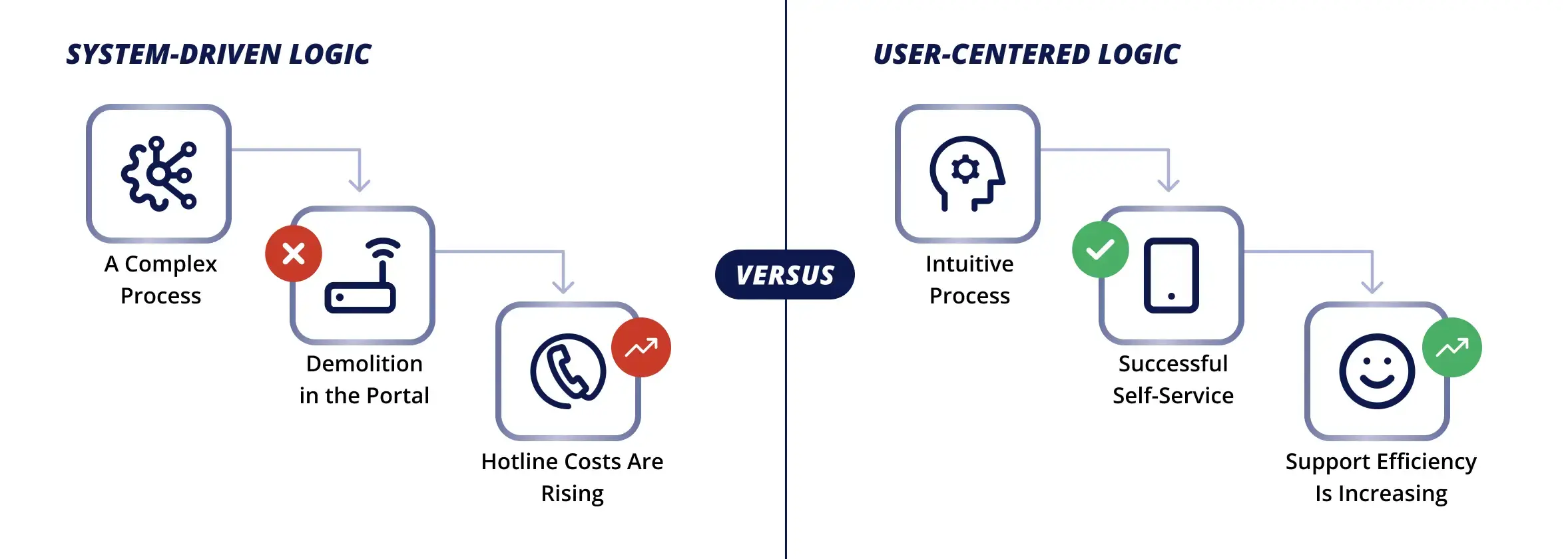
There’s often a misunderstanding when it comes to digitizing customer service: Many companies invest in apps, portals, and self-service features to reduce the load on their hotline. The assumption is that more features will automatically lower the volume of calls. In reality, however, even the smallest hurdles—such as incomprehensible terms during router setup or unclear navigation when dealing with Wi-Fi issues—lead to frustration. Despite the app, customers then turn to the hotline. The result is rising costs and inefficient use of resources. The problem here rarely lies in the technology itself, but rather in the lack of user-centric logic. If an app doesn’t think like a human, users will abandon the process. Efficiency and user experience (UX) in customer service are therefore not merely a design issue, but a critical component of the business model.
What does human-centered design mean in the context of service?
To bridge this gap between technical offerings and actual usage, a shift in perspective is needed—away from a purely feature-based approach and toward human-centered design (HCD). At its core, HCD means that technology adapts to human logic, not the other way around. The goal is product development in which technology understands people. It is important here to distinguish between genuine knowledge and mere assumptions about customer needs. Targeted observations create objectivity that replaces the subjective assumptions of development teams who are blind to their own biases. The focus is on the actual behavior of end users in stressful situations, such as when a malfunction occurs or a feature is activated. In an iterative optimization cycle, moments of frustration are identified, and insights are fed directly back into the development process. In this way, the user experience is based on data from real-world experiences rather than mere assumptions.
How UX Testing Processes and Continuous Iteration Lead to the Best Solution
However, a theoretical focus on people alone is not enough. It must be consistently validated in practice, because true optimization is only possible through continuous testing. A cycle of prototyping, testing, refinement, and retesting directly influences the conversion rate and the volume of support requests. In this process, the focus shifts from subjective perceptions to measurable process drop-offs. Data-driven optimization loops systematically eliminate obstacles. The goal is to develop products that work without additional instructions and offer self-explanatory processes. Rather than simply piling on features, the emphasis is on intuitive usability, which makes processes more efficient and ensures they run smoothly for the user without avoidable obstacles.
Why is user experience in customer service economically important for ISPs?
For Internet Service Providers (ISPs), UX is of great economic importance because complex processes such as router configuration often cause stress for customers. Especially on time-sensitive days like the day of service activation, the pressure to resolve issues immediately is high. A good UX has a direct impact on the first-contact resolution rate and thus on the cost per ticket. Successful self-service completions reduce support minutes and shorten process turnaround times. The customer experience thus becomes a driver of operational efficiency. The economic benefit is evident in the prevention of process drop-offs and increased customer loyalty through seamless workflows during critical phases.
How We Put Human-Centered Design into Practice
For us, human-centered design means constantly comparing our assumptions with reality. That’s why we regularly test new features under realistic conditions, identify obstacles early on, and incorporate the insights we gain directly into further development. In our next blog post, we’ll show you exactly how these tests are conducted and why the unbiased perspective of new test participants is so valuable in this process.




.webp)