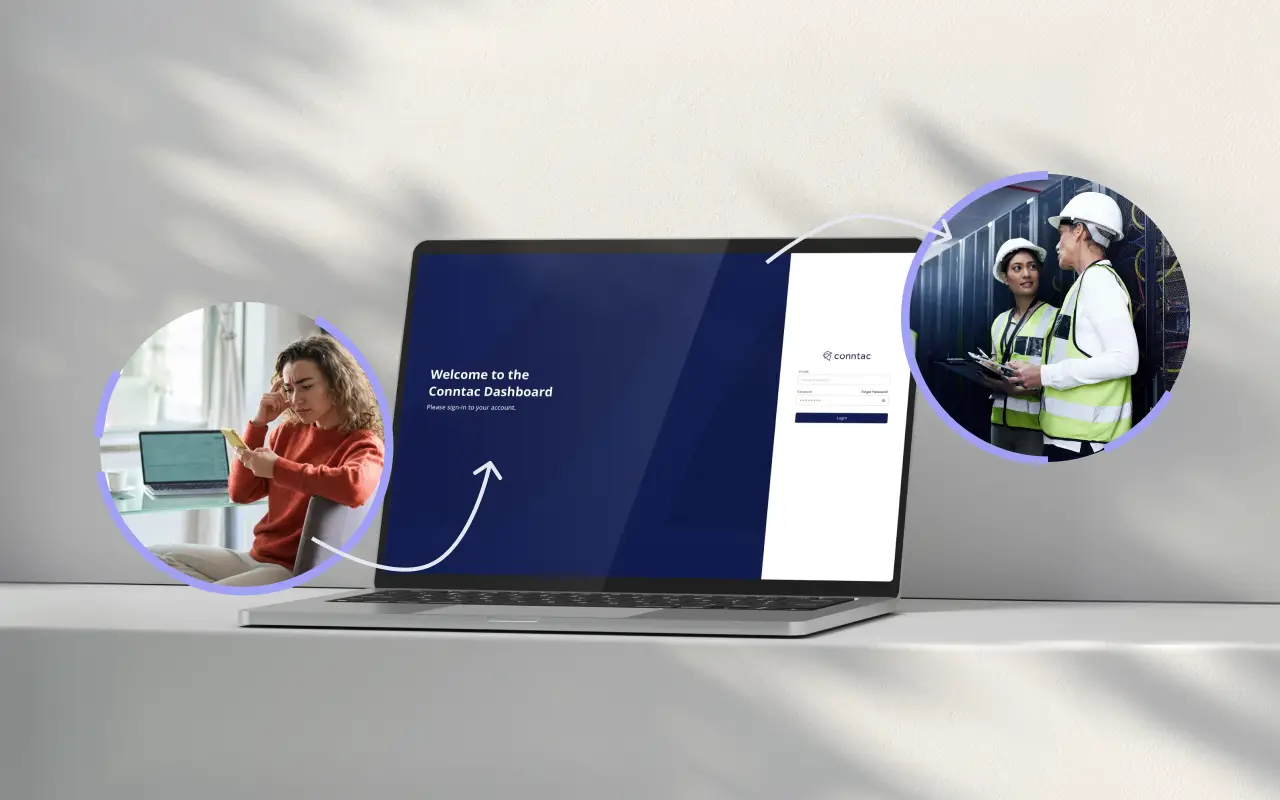
Technical service often begins digitally today. Customers look for a solution themselves in the self-service portal, have their technical situation analyzed, or contact customer support. Some issues can be resolved immediately. Others require additional checks, internal coordination, or an on-site visit.
These transitions determine whether the service process remains seamless. Can existing information be reused? Are responsibilities clear? Is the deployment prepared? And do the results from the field flow back in a structured manner?
End-to-End service therefore considers the entire journey of a technical request: from digital interaction and internal coordination to operational execution.
What does end-to-end service mean?
End-to-end service describes a service process where individual stages are aligned with one another. This creates a cohesive experience for customers, regardless of how many internal teams, systems, or service providers are involved.
In technical customer support, this process can include several stages:
- A request is recorded digitally.
- The technical situation is analyzed.
- Customers receive appropriate solution steps.
- Open cases are categorized and processed further.
- Responsibilities and appointments are coordinated.
- Necessary service calls are carried out safely.
- Status and results are documented.
Consistency means that relevant information is preserved at every transition and can be utilized in the next process step.
Why individual digital solutions do not yet create a seamless process
Many companies have already digitized individual areas of their service. Self-service offerings assist customers with troubleshooting, ticketing systems structure inquiries, and field service solutions support on-site operations.
Nevertheless, the overall process can remain fragmented. Typical gaps occur when:
- information is entered multiple times,
- analysis results do not reach the next processing step,
- responsibilities are clarified outside the system,
- status updates are requested via phone or messenger,
- access and security requirements are organized separately,
- feedback from the field is missing or arrives late,
- documentation is stored in different systems.
The very interaction between self-service, CRM, and ticketing shows that functional individual solutions do not yet result in a seamless workflow. The transitions between the involved areas must also be considered.
The three levels of a seamless service process
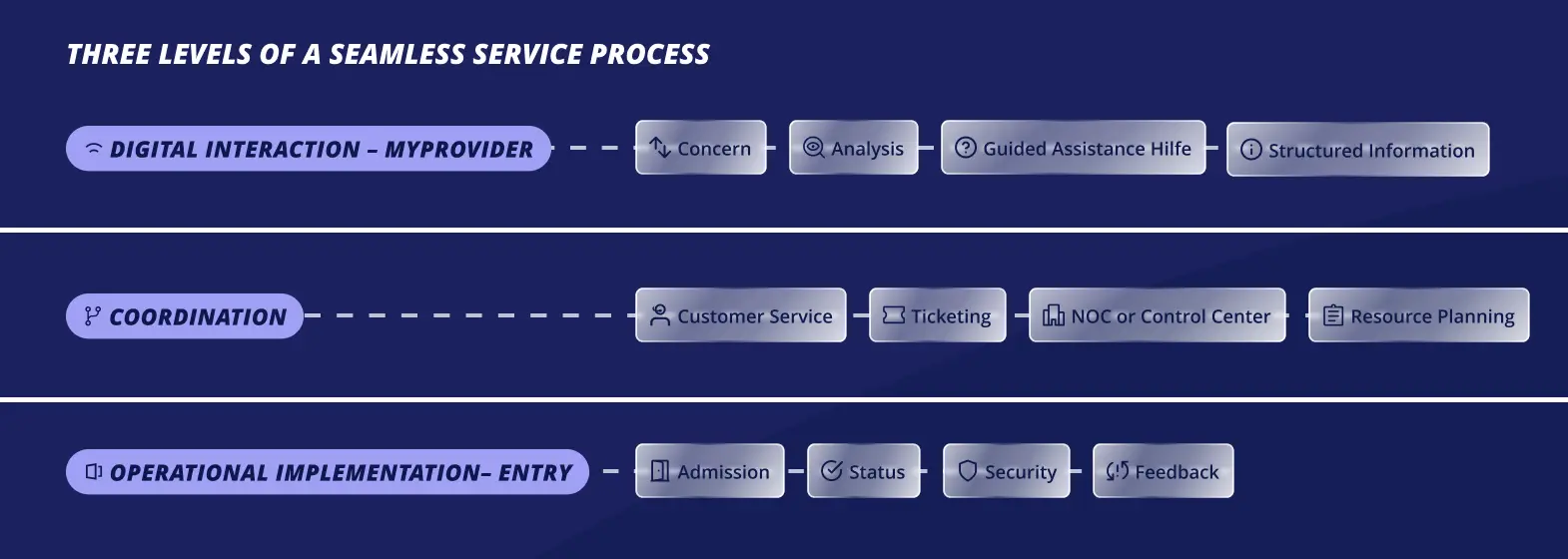
Technical service processes can be divided into three levels:
1. Digital interaction
This is where contact with customers begins. Inquiries are recorded, technical situations are analyzed, and appropriate solution steps are provided.
These include, for example:
- digital self-service,
- guided troubleshooting,
- technical diagnostics,
- provision of relevant information,
- structured preparation for further processing.
2. Coordination
Open requests must be categorized and handed over to the appropriate departments. Depending on the organization, this may involve customer service, ticketing, Network Operations Center, control centers, resource planning, or external service providers.
Key tasks include:
- assessing urgency and context,
- determining responsibilities,
- providing information,
- scheduling appointments and resources,
- clarifying access and security requirements.
3. Operational Execution
This is the level where on-site work takes place. Regulated access, transparent status updates, appropriate security processes, and clear feedback are essential.
These three levels can be managed by different systems and stakeholders. Their interoperability determines how reliably the overall process functions.
Which information must be retained between levels
Not every piece of information needs to be carried through the entire process. The crucial factor is that the next point of contact receives the necessary context.
This can include:
- Nature and timing of the request,
- Analyses already performed,
- Results from diagnostics and self-service,
- Devices used or affected connections,
- Previous troubleshooting steps,
- Urgency and priority,
- Responsible teams or service providers,
- Appointment and location information,
- Access requirements,
- Security protocols,
- Current processing or deployment status,
- Outcome and documentation of the service visit.
If this information is missing, the process often has to start over. Customers have to repeat their concerns, service teams have to research already known details, and technicians start a job with incomplete context. Service orchestration addresses exactly this: it looks at what information is needed where and how the involved departments can remain seamlessly connected.
How MyProvider supports digital interaction
MyProvider represents the digital layer of technical service. The solution helps customers to independently record and categorize technical issues.
Depending on the use case, MyProvider can:
- guide through structured solution steps,
- analyze the technical situation,
- narrow down potential causes,
- provide appropriate assistance,
- structure information for further processing.
The technical troubleshooting and problem solving helps customers narrow down causes and perform appropriate steps themselves. If the problem can be solved via self-service, they receive immediate support. If the issue persists, the information already gathered can enable more informed follow-up. Through appropriate ticketing functions information from the digital process can be made available for customer service. Digital contact thus becomes a structured starting point for the subsequent service process.
What needs to be coordinated between self-service and field operations
There are several organizational decisions between a digital analysis and a potential field visit. An open issue does not automatically lead to an on-site deployment.
First, it must be clarified:
- Is further remote inspection possible?
- Which team is responsible for handling it?
- Is a ticket required?
- Does a control center or NOC need to be involved?
- Is an on-site visit necessary?
- What qualifications and authorizations are required?
- When can the deployment take place?
- How is site access organized?
- What security requirements apply?
- Who needs to be informed about changes or delays?
This coordination depends heavily on the company's existing processes and systems. These may include CRM, ticketing, workforce management, or scheduling systems. The goal is to turn available information into a clearly prepared next step. Particularly important here is the coordination between field service and the NOC.
How Entry supports operational execution
Entry steps in where technical work on-site needs to be organized, secured, and documented.
The solution supports, among other things:
- the digital access management,
- check-in and check-out processes,
- tracking the current status of assignments,
- safety procedures for lone working,
- alerts and escalation processes in the field,
- the documentation of feedback and completions.
This gives managers greater transparency regarding ongoing assignments. At the same time, field personnel have access to important information and functions directly within the operational process.
Entry can be used as part of an existing Field Service Management landscape are used. Which systems are involved and how data is exchanged depends on the respective organizational and technical requirements.
Why Entry is also used independently of customer requests
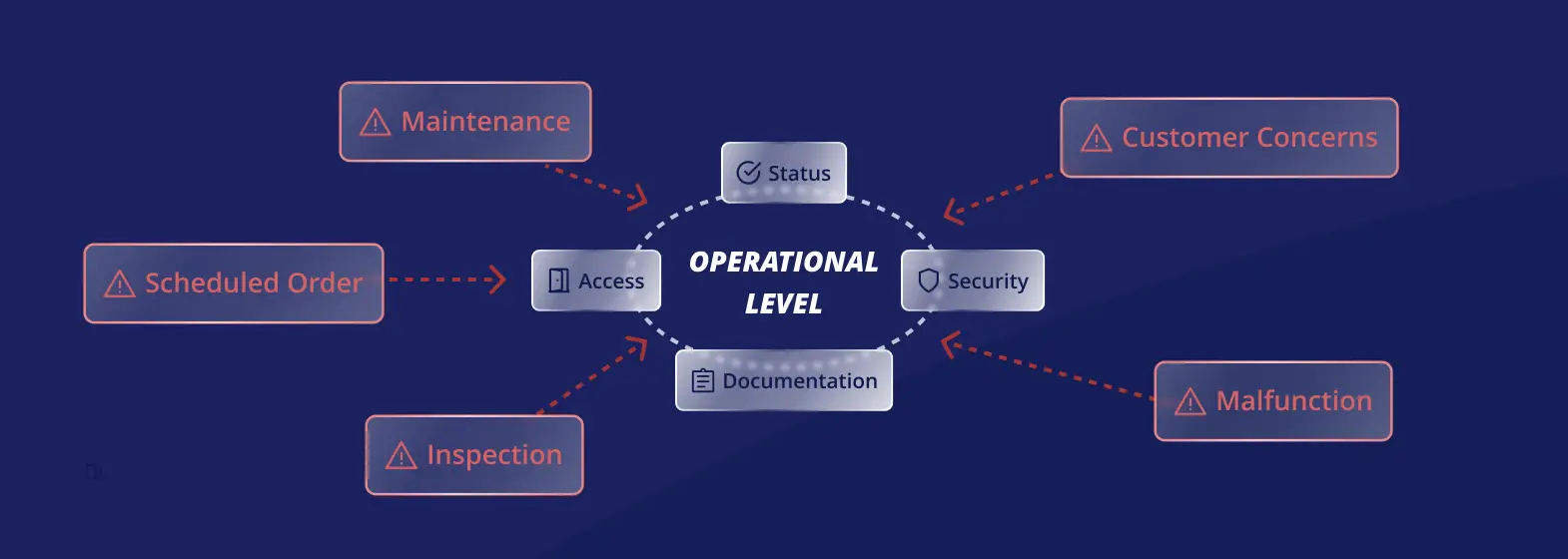
The operational level does not necessarily begin with a customer service request. Many field assignments arise from planned or infrastructure-related tasks.
Typical occasions for deployment include:
- Maintenance,
- Troubleshooting,
- Inspections,
- planned technical work,
- work on critical infrastructure,
- assignments for external service providers.
Here, too, access, status, security, and documentation must be reliably mapped. The operational process thus follows its own logic and can be connected to various upstream systems or planning processes.
This classification is important for the end-to-end model: A customer service case is one possible path to a field assignment. Maintenance, malfunctions, and planned work form other paths.
Where companies identify media discontinuities
Media discontinuities often appear in everyday work long before they become visible in key performance indicators. Recurring queries, manual data transfers, and missing status information provide clues.
The following questions are helpful for an initial assessment:
Digital interaction
- Is technical information captured in a structured way during the initial contact?
- Is it clear which analyses and solution steps have been carried out?
- Can service teams utilize existing results?
Coordination
- Are responsibilities clearly defined?
- Is information transferred manually between customer service, ticketing, the control center, and operational planning?
- Is it clear at all times which stage of processing a case is in?
- Are access and security requirements known in advance?
Operational execution
- Do on-site technicians have access to all the information they need?
- Is the current service status visible to the relevant departments?
- Are escalation paths clearly defined?
- Are results and deviations documented in a structured manner?
- Is feedback incorporated into further processing?
If negative responses accumulate in one area, it usually indicates a concrete starting point for improving the service process. A structured analysis of the entire service chain also creates the foundation for greater operational excellence in field service.
Target vision and current product status
The target vision is a technical service in which digital interaction, internal coordination, and operational execution are aligned. Information remains usable, responsibilities are clear, and the status of a process is traceable across all involved departments.
MyProvider and Entry address different levels within this model:
- MyProvider supports digital interaction, technical analysis, and guided troubleshooting.
- Entry supports the secure, transparent, and documented execution of technical field operations.
- Coordination is handled via the existing processes, systems, and responsible parties within the respective company.
The model describes an end-to-end service architecture. How the individual levels are technically connected depends on the existing system landscape and available interfaces. A pre-built automatic handover between MyProvider and Entry is therefore not a prerequisite for the conceptual approach. The focus is on how each process step is designed so that the next level can continue working with the necessary context. The article on System Integration in Field Service Management shows the possibilities and requirements involved.
FAQ: End-to-End Service in Technical Support
What is an end-to-end service process?
An end-to-end service process covers all relevant steps of a request—from initial contact and analysis to coordination, execution, and documentation. The individual stages are aligned so that information and responsibilities are not lost at system or team boundaries.
Do all systems need to be technically connected for this?
Full technical integration is not a mandatory starting point. Companies can first clarify their workflows, handovers, and information requirements. Which systems are subsequently connected depends on the existing infrastructure and available interfaces.
What role does self-service play in end-to-end service?
Self-service often forms the first point of contact. Customers can analyze their situation, follow guided troubleshooting steps, and provide relevant information. If an issue remains unresolved, these results should be usable for further processing.
When does a digital request become a field service call?
A field service call becomes necessary when a problem cannot be solved remotely or work must be performed directly on-site. Beforehand, factors such as responsibility, urgency, qualifications, scheduling, access, and safety requirements are clarified.
What is included in operational execution?
Operational execution includes the preparation and support of on-site work. This encompasses, for example, access, check-in, status updates, lone worker protection, alerting, escalation, and documentation.
Is the operational level limited to customer service cases?
No. The same requirements also arise for maintenance, inspections, repairs, planned work, and operations involving critical infrastructure.
How can media discontinuities be reduced?
The first step is to analyze the transitions. Companies should identify where information is being re-entered, requested by phone, or documented outside of the designated systems. From this, clear requirements for processes, responsibilities, and interfaces can be derived.
Conclusion: Service quality is created at the transitions
Digital self-service offerings, internal service processes, and solutions for field service fulfill different tasks. For customers, however, they are all part of a single, unified service experience.
A seamless technical service is created when the various levels are prepared for one another: digital interaction provides actionable information, coordination establishes clear responsibilities, and operational execution ensures a secure, transparent conclusion.
Anyone looking to digitize service processes should therefore look beyond individual contact points. The decisive factor is whether information, context, and accountability are maintained through to the next step.
Find out how MyProvider and Entry can support the different levels of your technical service.