.webp "Conntac Connect: Conversations with Network Operators and Municipal Utilities")
Personal exchange as a starting point
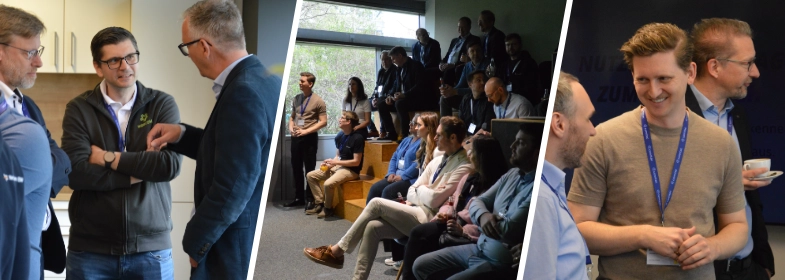
The first Conntac Connect in Augsburg was intentionally kept small. 25 customers, partners, and industry colleagues, one day at our office, plenty of time for discussions. The focus was not on a traditional presentation, but on an open guiding question: What challenges are currently emerging in the day-to-day operations of service organizations?
At the same time, it was about more than just professional exchange. Conntac Connect was also an invitation to give a real sense of who we are as a company – to show where we work, how we think, and what drives us. Augsburg is no random location. This is where Conntac originated. This is where we develop our solutions. And this is where the teams work daily on these very issues.
The day was therefore deliberately structured to combine both:
- Insights into our perspective on technical service
- and space for personal conversations and shared experiences
It was precisely this combination that made the difference.
The following thoughts are not a traditional event summary. They summarize recurring patterns from conversations, observations, and concrete examples.
A look at Conntac: Where we come from – and what we're working towards
Part of the day was also dedicated to our own development. We showed how Conntac came into being – from the first ideas in 2016 to today's solutions. It was less about milestones and more about a central theme: Technical service is often unnecessarily complicated – even though it doesn't have to be.
“Even a space shuttle can be repaired by non-experts if the instructions are clear enough.”
This idea continues to shape our work to this day.
In recent years, the market has changed significantly:
- further expansion
- more complexity
- increased demands on service organizations
What's striking: The challenges remain similar – they just occur more frequently and simultaneously.
“The challenges remain the same – but they are growing.”
This is precisely where we come in. Our perspective from the presentation: In service, what's often missing today isn't another individual solution. What's missing is an integrated system.
“What's missing now isn't technology, but structure in service.”
That's why we view service not as a single function, but as an interplay:
- End customers
- Service teams
- technical field service
Connected through clear processes, data, and a common logic.
.webp)
1. Rollout is no longer a bottleneck – usage is
Fiber optic rollout has progressed significantly in many regions. However, discussions repeatedly highlighted: The real challenge often begins only after connection. Connections are available – but usage doesn't develop automatically.
“The connection is there – but the real challenge only begins afterwards.”
Many customers are left to fend for themselves during go-live. Questions arise precisely when guidance is lacking. The result quickly becomes apparent in daily operations: uncertainty → contact → support effort
The bottleneck is thus increasingly in activation and usage – less so in the expansion itself.
2. Service in organizations is not growing at the same pace
With the expansion, demands on customer service are noticeably increasing.
More connections mean:
- more simultaneous activations
- more potential queries
- more complexity in operations
However, in many organizations, the structures are not keeping pace.
“We are expanding faster than we are developing our support processes.”
Existing processes are often designed for lower volumes and come under pressure as soon as scaling increases.
This quickly becomes apparent in everyday operations:
- longer processing times
- unclear responsibilities
- rising contact numbers
This also shifts the core question: The focus is not on the efficiency of individual measures, but on the fundamental organization of support.
3. Self-service changes more than just support
Self-service is often introduced to relieve the burden on support. However, discussions reveal a more nuanced picture.
“We have self-service – but inquiries still aren't decreasing.”
The key is how well users are guided through a process. Without this guidance, uncertainties arise – leading to new contacts. The effect, therefore, depends less on the tool itself and more on how clearly processes are designed.
Self-service therefore alters underlying requirements:
- Content must be understandable and contextually relevant
- Processes must build logically upon one another
- Users need clear next steps
Whether self-service is effective is determined by the specific usage situation.
4. Field service documentation becomes a critical factor
A recurring theme, especially in technical field service: documentation. With increasing complexity, the demands for traceability and accountability grow significantly.
"Often, we can't clearly trace what happened on-site."
In everyday operations, a familiar picture often emerges:
- Documentation exists, but is not consistently maintained
- Information is scattered across different systems
- Processes are not consistently followed
The problem rarely stems from a lack of knowledge. Much more often, there's a lack of clear accountability in the process. Without proper documentation, it becomes difficult to ensure quality and reliably manage operations.
5. Support Becomes Part of the Product Strategy
One idea has emerged from many discussions: Support significantly influences how a product is perceived.
It directly impacts
- whether usage occurs
- how customers experience the service
- how efficiently internal processes function
"The connection is not the product – the experience afterward is."
In a market with increasingly comparable infrastructure, differentiation is shifting. The focus is more on what happens after deployment. The quality of this experience determines satisfaction and usage. Support is thus moving closer to product and corporate strategy.
Key Takeaways
The Conntac Connect primarily showed one thing: many service challenges are well-known. However, with increasing scale and complexity, they become more visible and tangible. In many cases, it's not a lack of individual solutions. What's missing is a consistent connection between existing approaches.
Structure thus becomes the decisive factor:
- in processes
- in user guidance
- in service organization
"It's not a lack of solutions – it's a lack of them working together."
This is precisely where the further discussion begins.
Thank you for the exchange
In conclusion, there's one main thing to say: Thank you to everyone who attended Conntac Connect in Augsburg. For your openness, diverse perspectives, and personal exchange. And for allowing us not only to have professional discussions but also to get to know each other better as individuals and as an organization. It's precisely this connection that makes formats like Conntac Connect particularly valuable.